Cost & value comparisons · WSNC nutrition education
How to Compare Supplement Cost per Serving
The bottle price is only the beginning of a supplement value comparison. Cost per serving depends on the units in the selected package and the units in a serving; daily cost also depends on how many servings the directions describe. Use the calculator and worked example to compare the arithmetic without mistaking a low price for equivalent ingredients or individual suitability.

Start with the exact selected package
Record the package price and the number of tablets, capsules, scoops or other matching units. Confirm that the label you are reading belongs to that package, especially when several sizes share a product page.
Keep shipping, taxes and other checkout costs separate unless you deliberately include them in the entered price. Prices shown on catalog pages retain their actual recorded price-check dates; this educational guide does not refresh them.
Calculate servings before calculating cost
Divide package units by units per serving, then divide the price by the resulting servings. For a fictional $36 bottle containing 90 tablets with three tablets per serving, the bottle supplies 30 servings and each serving costs $1.20.
This is an illustrative example, not a current product offer. If the package lists servings per container directly, use that figure to check your arithmetic. For powders, compare matching weight or scoop units rather than mixing grams and scoops.
Distinguish cost per serving from cost per day
If the fictional example is used once daily, its daily cost is $1.20 and a 30-day estimate is $36. If the directions instead describe two servings daily, those figures become $2.40 and $72; the bottle lasts 15 days.
The calculator keeps serving size and servings per day separate for this reason. Enter the actual selected label or practitioner directions; do not change use to make a product look less expensive.
Compare like with like before judging value
Two bottles can have the same cost per serving while supplying different nutrients or ingredient amounts. Compare the full formula, intended role and dietary compatibility before treating the price figures as evidence of equivalence.
For a multi-product protocol, calculate each component’s daily contribution using its own directions, then compare the complete routine. Do not divide a kit price by one outer-package count as though every component has the same serving.
Ask whether a larger package fits the actual routine
A larger package may reduce the unit cost, but the practical comparison also includes expected use, storage and the reason the product is needed. Avoid buying a larger amount solely because its arithmetic is attractive.
Confirm that the compared options are the same formula and serving. A similarly named alternate version or dietary formulation may be a different comparison even when its bottle looks familiar.
Keep a clear comparison record for the next order
Write the exact product, package price, units per serving, daily servings and date of your own comparison. Save any questions about the formula separately from the calculated totals.
Use the linked product pages to explore their existing records, then confirm the final selected package at the authorized WSNC checkout. The calculator produces a budget estimate, not a recommendation to use a supplement.
Questions to guide a useful comparison
| Question | Why it matters | What to compare |
|---|---|---|
| Cost per serving | The package may require several units for one serving. | Price ÷ (package units ÷ units per serving). |
| Cost per day | Directions may describe multiple daily servings. | Cost per serving multiplied by actual servings per day. |
| Value | Different formulas can have similar arithmetic. | Ingredient contribution, dietary fit and the defined purpose. |
Calculate serving and daily cost
Enter the price and matching units from the selected package. The starting values are an illustrative example, not a current WSNC offer. Use label or practitioner directions for the daily serving count.
- Servings per package
- 30
- Cost per serving
- $1.20
- Cost per day
- $1.20
- Estimated cost for 30 days
- $36.00
- Days per package
- 30
Enter a nonnegative price and positive, finite unit and serving values.
The estimate excludes shipping and tax unless you include them in the entered price. Fractional servings are shown mathematically; confirm practical servings on the package. Cost does not establish equivalent formulas or suitability.
Compare recorded product labels and directions
These examples show different formula approaches. Their inclusion does not establish suitability for every reader, equivalent effects, or approval to take them together.
| Product | Listing focus | Declared formula in brief | Label directions |
|---|---|---|---|
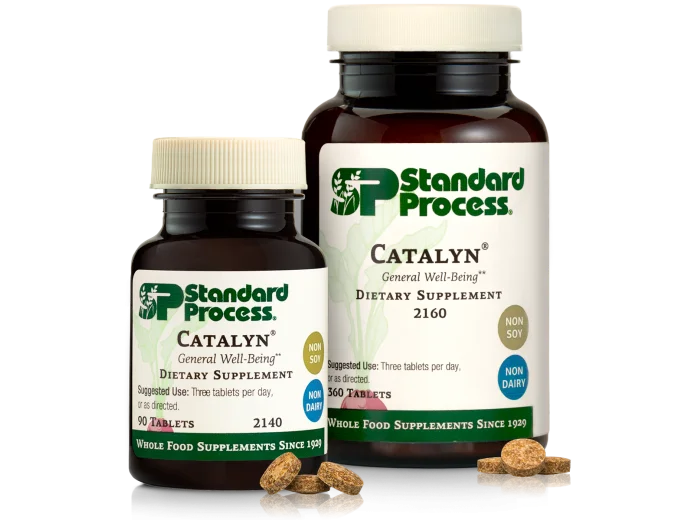
| Catalyn®View product →Standard Process | Foundational whole-food nutrition with vitamin catalysts designed to help bridge everyday nutritional gaps and support overall well-being.* | Contains vitamins plus defatted wheat germ, calcium lactate, organic carrot and sweet potato, nutritional yeast, bovine and ovine tissue ingredients, organic plant juice powders, mushrooms and rice bran. Contains wheat. | Three tablets daily, or as directed by your healthcare practitioner.Full ingredients and cautions → |
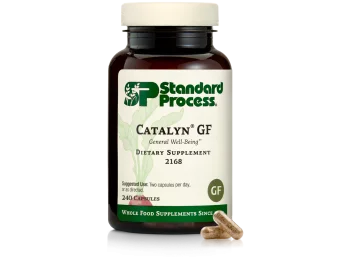
| Catalyn® GFView product →Standard Process | Supports overall well-being* | Two capsules declare vitamin A 360 mcg RAE, vitamin C 4 mg, vitamin D 7.8 mcg, thiamin and riboflavin 0.2 mg each, vitamin B6 1 mg and an 825 mg blend. Rice bran replaces wheat germ; the formula still includes animal tissues, honey and a gelatin capsule. | Two capsules per day, or as directed.Full ingredients and cautions → |
| Magnesium LactateView product →Standard Process | Magnesium Lactate delivers essential magnesium for system-wide cellular function* | Each Serving Size (2 Tablets) contains: Calories 10, Total Carbohydrate 1 g, Magnesium 200 mg. Ingredients: Magnesium lactate and calcium stearate. | Two tablets per day, or as directed.Full ingredients and cautions → |
Questions about cost & value comparisons
What is the formula for cost per serving?
Divide package price by servings per container. If you only have unit count, first divide package units by units per serving.
Why can cost per day be higher than cost per serving?
A daily routine may use more than one serving. Multiply the per-serving cost by actual daily servings, using the selected label or practitioner directions.
Does the cheaper serving mean the formulas are equivalent?
No. Compare ingredients, declared amounts, dietary compatibility and the intended role first. Price arithmetic does not establish equivalent effects.
Evidence and product information sources
Public health references explain nutrition and evidence limits; they do not endorse WSNC or these products. The product table uses existing catalog records. No new clinician review, label refresh or price update is claimed.