Combining supplements · WSNC nutrition education
Can You Take These Supplements Together?
Whether supplements can be taken together depends on the complete formulas, actual daily amounts, medicines and individual health context. Matching two product names is not enough. This guide shows how to prepare a clear combination review; it does not provide a universal safe-pairing list or replace a pharmacist’s assessment.
Create one inventory of everything you use
List the exact version and package of each supplement, plus nutrition powders, packs and occasional products. Include the current serving directions and how you actually use them.
Add prescription and over-the-counter medicines to the list you bring to the pharmacist. FDA explains that medicines and supplements can interact; assessing only two new bottles leaves important context out.
References: FDA: Mixing medications and supplements
Calculate daily amounts before judging overlap
For each declared nutrient, multiply the amount per serving by the number of servings used per day. Add matching units across products. Keep micrograms and milligrams distinct, and do not add a percentage Daily Value as though it were an ingredient amount.
If the necessary amount is not disclosed, mark it as unknown. A proprietary blend’s total weight does not reveal the amount of every constituent, so the missing information is a question for review.
Use a simple example without turning it into a dose plan
Suppose a fictional multivitamin contributes 10 micrograms of vitamin D per daily serving and another fictional product contributes 25 micrograms. The combined supplement contribution is 35 micrograms per day. This arithmetic does not establish suitability or account for every other source.
Use the same method with your real labels, then ask how the result fits the relevant intake guidance and your circumstances. The example is intentionally not an instruction to take either product.
Check repeated botanicals and every pack component
Nutrient totals are only one part of the review. List repeated herbs, extracts and other ingredients by their exact names and preparation where declared. Do not assume that two similar blends contain identical amounts.
Open every component in a protocol or daily pack. A bundle can repeat a product you already own, even when the outer kit name sounds like a different goal.
Keep timing questions separate from compatibility
Taking products at different times does not automatically resolve every interaction or an excessive combined amount. Ask the pharmacist which timing instructions apply to the exact medicines and formulas on your list.
Keep those instructions written down and follow the selected label. Do not invent a universal morning-versus-evening schedule from a product category.
Use the review to simplify the routine
For every repeated ingredient, ask whether both products have a distinct reason to remain in the plan. Record unresolved amounts or cautions before purchasing another bottle.
After the review, keep one agreed list with exact products and directions. The table below illustrates label comparisons; it does not approve the linked formulas as a combination.
Questions to guide a useful comparison
| Question | Why it matters | What to compare |
|---|---|---|
| Duplicate nutrients | Several products may supply the same nutrient. | Amount per serving multiplied by actual daily servings. |
| Botanical overlap | A repeated herb may appear in different preparations. | Exact names, extracts and disclosed amounts. |
| Medicines and timing | A pairing list omits individual context. | The complete routine and pharmacist instructions. |
Compare recorded product labels and directions
These examples show different formula approaches. Their inclusion does not establish suitability for every reader, equivalent effects, or approval to take them together.
| Product | Listing focus | Declared formula in brief | Label directions |
|---|---|---|---|
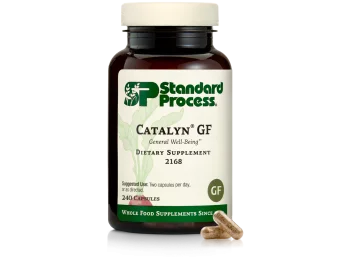
| Catalyn® GFView product →Standard Process | Supports overall well-being* | Two capsules declare vitamin A 360 mcg RAE, vitamin C 4 mg, vitamin D 7.8 mcg, thiamin and riboflavin 0.2 mg each, vitamin B6 1 mg and an 825 mg blend. Rice bran replaces wheat germ; the formula still includes animal tissues, honey and a gelatin capsule. | Two capsules per day, or as directed.Full ingredients and cautions → |
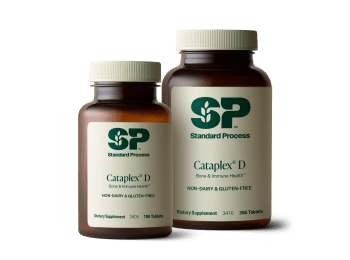
| Cataplex® DView product →Standard Process | Supports bone health, mineral absorption and immune system* | Per two tablets: vitamin A 300 mcg RAE, vitamin D 40 mcg and calcium 60 mg. Current ingredients: calcium lactate, potassium citrate, glycerine, acacia fiber, modified corn starch, sucrose, calcium stearate, vitamin A palmitate, ascorbic acid and cholecalciferol. | Two tablets daily, or as directed.Full ingredients and cautions → |
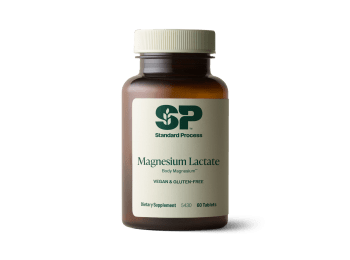
| Magnesium LactateView product →Standard Process | Magnesium Lactate delivers essential magnesium for system-wide cellular function* | Each Serving Size (2 Tablets) contains: Calories 10, Total Carbohydrate 1 g, Magnesium 200 mg. Ingredients: Magnesium lactate and calcium stearate. | Two tablets per day, or as directed.Full ingredients and cautions → |
Questions about combining supplements
Does taking supplements hours apart make any combination safe?
No. Timing is only one question. The full formulas, total amounts and medicines still require review.
Can I add percentages of Daily Value from different products?
Use the actual nutrient amounts and consistent units when reviewing the daily routine. Percentages alone can obscure serving-size and labeling differences.
Does this page approve the products below for use together?
No. Their recorded labels illustrate what to compare. A pharmacist or practitioner must assess a proposed combination in your individual context.
Evidence and product information sources
- FDA: Mixing medications and supplements ↗
- FDA: Information for supplement consumers ↗
- Authorized WSNC Standard Process store information ↗
Public health references explain nutrition and evidence limits; they do not endorse WSNC or these products. The product table uses existing catalog records. No new clinician review, label refresh or price update is claimed.