Women over 50 · WSNC nutrition education
Vitamins & Supplements for Women Over 50
The best starting point for comparing vitamins and supplements for women over 50 is your diet and health context, not an automatic age-based stack. Bone nutrition, nutrient absorption, activity and dietary restrictions can raise different questions. Use this guide to organize those questions and compare recorded Standard Process formulas without assuming that a women’s label establishes individual suitability.

Start with what changed in your daily routine
List recent changes in meals, activity, appetite and the supplements you already use. Include fortified foods and shakes, since they may supply nutrients you are also considering in tablets. Keep the description concrete: which meals are difficult, which ingredients you avoid and what you want a product to contribute.
Being over 50 is a navigation aid for this guide, not a diagnosis or a reason to purchase every listed product. Two women of the same age may need very different comparisons.
Compare calcium and vitamin D in the context of food
NIH lists a calcium intake recommendation of 1,200 mg per day for women ages 51–70. That is total intake, not a direction to take that amount as a supplement. A food review helps frame a more specific question about any remaining gap.
Put a calcium formula and vitamin D formula in separate columns on your comparison sheet. Record the amount per serving, how many servings the directions describe and amounts in other products. Do not compare them simply by bottle size.
References: NIH ODS: Calcium
Ask different questions about B12 and iron
NIH notes that some older adults have difficulty absorbing B12 naturally present in food. Ask whether your dietary pattern or health history makes B12 a relevant question before selecting a blend that happens to include it.
Iron deserves its own discussion; continued menstruation, diet and a clinician’s assessment can matter. Do not carry a previous iron-containing routine forward merely because the packaging still says women’s nutrition.
References: NIH ODS: Vitamin B12 · NIH ODS: Iron
Keep muscle and digestive nutrition in the same plan
Consider whether you want a protein contribution, additional fiber or a vitamin and mineral product. Those are different product roles. A shake may add calories and protein as well as several nutrients, while a fiber product has another purpose.
Compare protein and fiber amounts, serving size, sweeteners and dietary restrictions on the selected label. If remaining active is your central goal, the active-after-50 guide connects those comparisons to food and training questions.
Check the complete routine before adding another bottle
Write each product’s daily use next to its Supplement Facts panel. Look for repeated calcium, vitamin D, magnesium and other nutrients, including those in powders and packs. Bring the complete list to a practitioner rather than asking about a new bottle alone.
A straightforward routine is easier to compare, budget and discuss. Keep the reason for each item next to its name so you can distinguish ongoing dietary support from a product bought for an old concern.
Use focused guides to resolve the remaining questions
Our women’s health collection remains the broader starting point for product discovery. Continue to the menopause nutrition guide if that life stage is your main question, or to the sleep guide if sleep is the reason you began searching.
The linked products below provide examples to compare against the recorded labels. Check the exact package and current authorized listing before ordering; this page does not establish a personalized supplement plan.
Questions to guide a useful comparison
| Question | Why it matters | What to compare |
|---|---|---|
| Bone nutrition | Total intake matters more than an age claim on the front label. | Dietary calcium, declared amounts and other nutrient products. |
| B12 question | Diet and absorption context deserve a focused discussion. | B12 amount, form, serving directions and clinician advice. |
| Protein or fiber | A powder may have a different role from tablets. | Grams per serving, calories, ingredients and dietary fit. |
Compare recorded product labels and directions
These examples show different formula approaches. Their inclusion does not establish suitability for every reader, equivalent effects, or approval to take them together.
| Product | Listing focus | Declared formula in brief | Label directions |
|---|---|---|---|
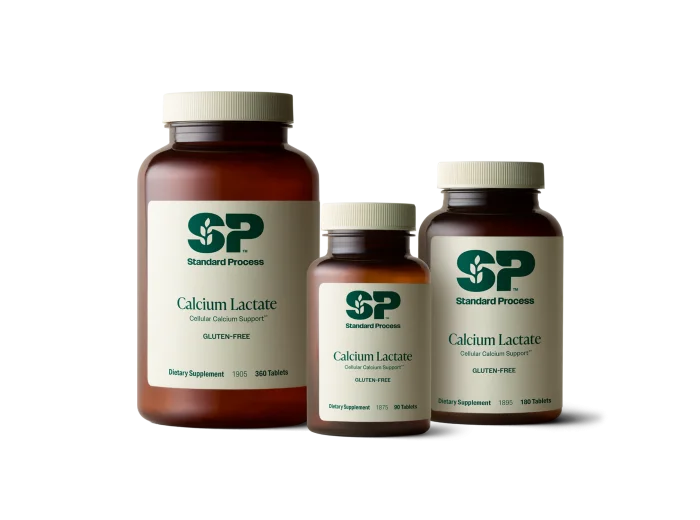
| Calcium LactateView product →Standard Process | A vegan, non-dairy calcium-and-magnesium formula supporting healthy bone structure, muscle contraction, nerve transmission and cellular function.* | Three tablets provide calcium from calcium lactate and calcium stearate plus magnesium from magnesium citrate. | Three tablets per day, or as directed by your healthcare practitioner.Full ingredients and cautions → |
| Cataplex® DView product →Standard Process | Supports bone health, mineral absorption and immune system* | Per two tablets: vitamin A 300 mcg RAE, vitamin D 40 mcg and calcium 60 mg. Current ingredients: calcium lactate, potassium citrate, glycerine, acacia fiber, modified corn starch, sucrose, calcium stearate, vitamin A palmitate, ascorbic acid and cholecalciferol. | Two tablets daily, or as directed.Full ingredients and cautions → |
| Cataplex® B12View product →Standard Process | Supports blood health and general well-being* | Each tablet supplies vitamin B12 6 mcg and a 355 mg blend of bovine liver, organic carrot, organic sweet potato, calcium lactate, porcine stomach parenchyma, bovine spleen, ovine spleen, bovine adrenal extract and oat flour. | One tablet per day, or as directed.Full ingredients and cautions → |
| Whole Food FiberView product →Standard Process | Whole Food Fiber is a good source of fiber from nutrient-rich whole foods | Each Serving Size (1 Level Tablespoon) contains: Calories 25, Total Carbohydrate 6 g, Dietary Fiber 3 g, Total Sugars <1 g, Protein <1 g. Proprietary Blend 6.9 g: Oat fiber, beet fiber, rice bran, organic beet (root), apple pectin, organic carrot, organic sweet potato, and carrot fiber. | One level tablespoon (approximately 6.9 grams) in a blender drink per day, or as directed.Full ingredients and cautions → |
Questions about women over 50
Does every woman over 50 need a multivitamin?
No age cutoff establishes that everyone needs the same formula. Compare dietary intake, the nutrients supplied and any existing products before deciding whether a broad formula or targeted product has a useful role.
Should I keep taking the same iron supplement after menopause?
Ask your clinician about your current need. Do not assume that a past reason for taking iron remains unchanged, and do not use this guide to stop prescribed treatment.
Are these formulas specially labeled for women over 50?
Not necessarily. These are existing catalog examples for specific comparisons, not a claim that each product is an age-specific formula.
Evidence and product information sources
- NIH ODS: Calcium ↗
- NIH ODS: Vitamin B12 ↗
- NIH ODS: Iron ↗
- FDA: Information for supplement consumers ↗
- Authorized WSNC Standard Process store information ↗
Public health references explain nutrition and evidence limits; they do not endorse WSNC or these products. The product table uses existing catalog records. No new clinician review, label refresh or price update is claimed.